
Common Security Risks in Mobile Apps and How to Fix Them

What You’ll Learn in This Blog
- Data Breaches: A Costly Wake-Up Call
- Ignoring the OWASP Mobile Top 10
- Insecure Data Storage
- Weak Authentication and Session Management
- API Attacks: The Silent Threat
- Lack of Secure Coding Standards
- React Native Security Challenges
- Skipping Penetration Testing
- Security Best Practices
- Why Security Should Be Built Into Development
1. Data Breaches: A Costly Wake-Up Call
Data breaches are one of the biggest threats to mobile applications today. A single vulnerability can expose millions of user records, leading to financial loss and loss of trust. Common causes include weak encryption, insecure APIs, and poor backend security.Real-world impact:
- Millions of user records exposed globally every year
- Heavy financial penalties for companies
- Long-term damage to brand reputation
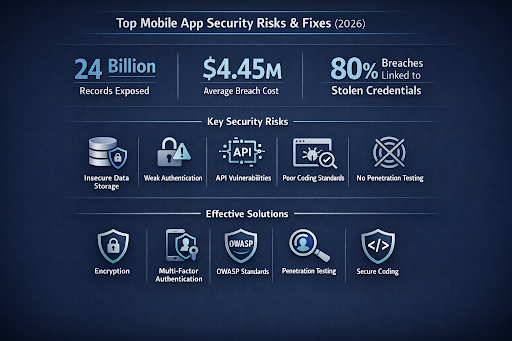
Fix it:
- Implement strict access controls
- Encrypt all sensitive user data
- Audit third-party integrations regularly
2. Ignoring the OWASP Mobile Top 10
The OWASP Foundation publishes the OWASP Mobile Top 10, which highlights critical app security risks.
These include insecure communication, weak cryptography, and improper platform usage.
Many developers ignore this list during planning, which leads to major vulnerabilities.
Fix it:
- Use OWASP as a security checklist
- Conduct regular code reviews
- Integrate security testing early
3. Insecure Data Storage
One of the most common risks is insecure data storage in mobile apps.
Sensitive data stored without encryption can be extracted from lost or stolen devices.
Some apps have stored login tokens in plain text, leading to serious vulnerabilities.
This creates both Android and iOS security issues.
Fix it:
- Use encrypted storage like Keychain or EncryptedSharedPreferences
- Avoid storing passwords locally
- Apply strong encryption techniques
4. Weak Authentication and Session Management
Weak login systems are a major cause of security breaches.
Over 80 percent of hacking-related breaches involve compromised credentials.
Choosing the right authentication methods is critical.
Fix it:
- Enable multi-factor authentication
- Use biometric login such as Face ID or fingerprint
- Implement secure session handling and token expiration

5. API Attacks: The Silent Threat
Modern apps depend heavily on APIs. Unfortunately, poor API security in mobile applications is one of the fastest-growing risks. In 2022, T-Mobile suffered a breach that exposed millions of customer records due to API weaknesses. Fix it:- Use API gateways
- Apply rate limiting
- Validate all server-side requests
- Avoid exposing sensitive endpoints publicly
6. Lack of Secure Coding Standards
Rushed releases often ignore secure coding practices for mobile apps. Hardcoded keys, improper error handling, and outdated libraries create serious vulnerabilities. Security must be part of your development culture — not just a final testing step. Fix it:- Train developers on secure coding
- Use static code analysis tools
- Keep dependencies updated
- Conduct peer code reviews
7. React Native Security Challenges
Cross-platform frameworks like React Native speed up development, but they introduce unique risks. Poor bridge configuration, exposed debug modes, or insecure third-party plugins can compromise React Native security. That doesn’t mean you shouldn’t use it it just requires proper handling. Fix it:- Disable debug mode in production
- Secure communication between JavaScript and native modules
- Regularly update dependencies
8. Skipping Penetration Testing
Many startups launch apps without conducting mobile app penetration testing. That’s like leaving your house unlocked and hoping no one tries the door. Ethical hackers simulate real attacks to uncover weaknesses before criminals do. Fix it:- Perform penetration tests before launch
- Re-test after major updates
- Combine automated and manual security assessments
9. Not Following Mobile Application Security Best Practices
Security isn’t a single solution it’s a layered approach. Following mobile application security best practices ensures long-term resilience. This includes:- Encrypting data in transit and at rest
- Regular vulnerability assessments
- Role-based access controls
- Monitoring unusual activity
Why Security Should Be Built Into Development
When security is integrated from day one, the cost of fixing issues drops dramatically. According to industry research, fixing a vulnerability after release can cost 30x more than resolving it during development. At Elements Labs , we focus on building secure, scalable mobile solutions from the ground up. Our team integrates protection measures throughout the entire mobile app development lifecycle — not just at the end. If you’re planning a new project or want to audit an existing product, securing your platform today can save you from massive losses tomorrow.
Helpful Resources
- OWASP Foundation – Mobile Security Testing Guide
- National Institute of Standards and Technology – Mobile Security Framework
- IBM – Cost of Data Breach Report
- Verizon – Data Breach Investigations Report
Ready to Protect Your App?
If you’re serious about growth, security must be a priority not an afterthought. Whether you need a secure MVP, a full product build, or a vulnerability audit, the right strategy makes all the difference.
Partner with Elements Labs to build high-performance apps that users trust. Let’s strengthen your application, protect your users, and future-proof your business.
Contact Elements Labs today to secure your next mobile project.