
Articles on Development Process, Coding Process & Quality Process of Element Labs
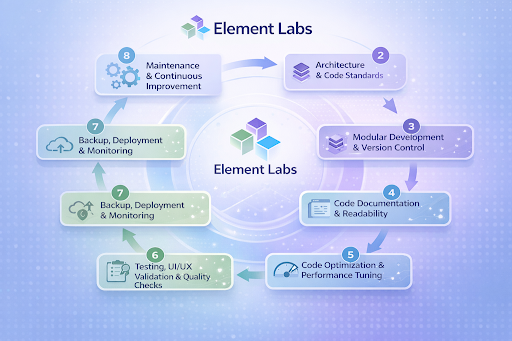
Building a successful digital product requires a structured engineering workflow, careful planning, and continuous quality monitoring. At Element Labs Inc, development follows a well-defined process that ensures every application is scalable, reliable, and user-focused.
From the initial requirement discovery stage to long-term product maintenance, each step of the development lifecycle is designed to deliver stable, high-performance software solutions.
1. Requirement Discovery & Planning
The development process begins with understanding business objectives, user requirements, and technical expectations.
During this stage:
- Business goals are documented
- User journeys and workflows are mapped
- Feature lists are created
- Design structures are translated into Figma project pages
Finalizing scope, features, and technology stacks early prevents development bottlenecks and reduces costly revisions later in the project.
2. Architecture & Code Standards
Once requirements are finalized, engineers design the system architecture.
This includes:
- backend architecture planning
- API structure design
- database schema planning
- coding guidelines and standards
Clear architecture ensures the application remains organized, scalable, and easy to maintain.
3. Modular Development & Version Control
Development at Element Labs follows a modular approach where features are built as independent components.
Git-based workflows allow engineers to:
- create development branches
- review code changes
- test features before integration
This ensures stability while enabling multiple developers to collaborate efficiently.
4. Code Documentation & Readability
Readable code is essential for long-term maintainability.
Developers focus on:
- clear variable naming
- meaningful comments
- technical documentation
This makes it easier for future developers to maintain and extend the system.
5. Code Optimization & Performance Tuning
Before moving to testing, engineers optimize the application for performance.
Optimization includes:
- reducing redundant code
- improving database query performance
- optimizing frontend rendering
- improving API response times
These improvements ensure the application performs efficiently under real-world usage.
6. Testing, UI/UX Validation & Quality Checks
After development, designers and QA engineers validate the product.
Testing ensures:
- design consistency with approved prototypes
- functional accuracy
- usability and performance reliability
- Backup, Deployment & Monitoring
Automated backups are implemented throughout development to protect both code and databases.
Deployment includes:
- secure server configuration
- automated deployment pipelines
- system monitoring tools
These safeguards ensure stable product launches and quick recovery if issues arise.
8. Maintenance & Continuous Improvement
Product development continues even after launch.
Element Labs monitors application performance and provides:
- bug fixes
- performance improvements
- security updates
- feature enhancements
This continuous improvement ensures the product evolves alongside business needs.