
Startup & tech business
Top Startup Tech Stack in 2026 for Successful Startups
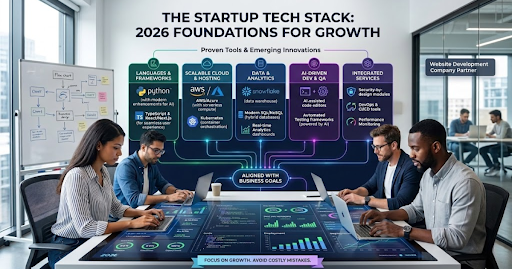
From front-end frameworks and back-end technologies to cloud infrastructure, AI integrations, and DevOps tools, selecting the best startup tech stack helps businesses launch faster, reduce technical debt, and scale efficiently in a competitive digital market.
Choosing the right Startup Tech Stack in 2026 is one of the most important decisions for modern founders. The technologies you choose directly impact scalability, development speed, user experience, security, and long-term operational costs.
From front-end frameworks and back-end technologies to cloud infrastructure, AI integrations, and DevOps tools, selecting the best startup tech stack helps businesses launch faster, reduce technical debt, and scale efficiently in a competitive digital market. In this guide, we explore the best technology stack for startups in 2026 and explain how partnering with a trusted website development company can help future-proof your digital product for long-term growth.
1. Why the Startup Tech Stack Matters in 2026
Your Startup Tech Stack in 2026 is more than just a collection of tools and frameworks — it is the foundation of your entire digital product. The wrong technology choices can create scalability problems, security vulnerabilities, slow performance, and expensive maintenance costs as your business grows.
The right startup tech stack, however, helps businesses build faster, scale efficiently, and deliver a better user experience from day one. A strong technology foundation can provide:
- Faster development cycles
- Easier integration with third-party services
- Better performance and user experience
- Lower infrastructure and maintenance costs
- Long-term scalability and adaptability
- Improved security and reliability
For modern startups, where time, budget, and resources are limited, choosing the right technology stack is critical. The best technology for startups in 2026 should balance innovation, flexibility, performance, and long-term business growth.
2. Best Front-End Technologies for Startups in 2026
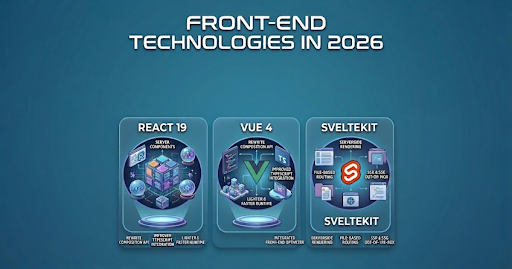
The front-end is the first impression users have of your product, and in Startup Tech Stack in 2026, modern frameworks are evolving rapidly to support speed, scalability, AI-driven personalization, and seamless user experiences.
React 19
React 19 continues to dominate the front-end ecosystem with advanced server-side rendering (SSR), improved performance optimization, and AI-driven UI personalization capabilities. Its massive ecosystem, strong TypeScript support, and compatibility with modern development tools make it one of the best choices for scalable startup applications.
For founders building a modern startup tech stack in 2026, React provides long-term flexibility, stability, and enterprise-level scalability.
Vue 4
Vue 4 remains a lightweight and developer-friendly framework with a smooth learning curve and excellent flexibility. Its enhanced reactivity system, micro-frontend architecture support, and smaller bundle sizes help startups create faster and more modular applications.
For startups looking for agility and faster development cycles, Vue is a strong option in the best tech stack for startup products.
SvelteKit
SvelteKit has become increasingly popular because it compiles code at build time instead of relying on a virtual DOM. This results in faster performance, lower memory usage, and highly optimized applications.
In 2026, SvelteKit offers robust routing, server-side rendering, and seamless cloud deployment integrations, making it a strong contender for startups focused on performance and simplicity.
Mobile-First Development
For mobile-first startups, Flutter 4 and React Native continue to lead cross-platform development. Both frameworks allow businesses to build Android and iOS applications from a single codebase while maintaining near-native performance and faster development speed.
Choosing the right front-end framework ensures your Startup Tech Stack 2026 delivers fast, responsive, and engaging digital experiences that modern users expect.
3. Best Back-End Technologies for Scalable Startups

A strong back-end architecture is essential for building scalable, secure, and high-performing applications. In a modern Startup Tech Stack in 2026, choosing the right back-end technology helps startups manage growth, improve performance, and reduce long-term maintenance challenges.
Node.js 20
Node.js 20 remains one of the most popular back-end technologies for startups because of its event-driven architecture and real-time processing capabilities. With improved performance, native ES module support, and a massive developer ecosystem, Node.js is ideal for scalable web applications, APIs, SaaS platforms, and real-time products.
For founders building the best tech stack for startup growth, Node.js offers flexibility, speed, and faster development cycles.
Django 5
Django 5 continues to be a leading Python framework for startups focused on rapid development and security. Its built-in authentication system, ORM, admin dashboard, and security features significantly reduce development time while maintaining scalability.
Startups using Django benefit from faster product launches, reliable architecture, and easier maintenance, making it a strong choice in the technology for startups ecosystem.
Go (Golang)
Go, also known as Golang, is highly valued for its simplicity, efficiency, and excellent concurrency model. It is widely used for microservices, cloud-native applications, APIs, and high-performance systems.
For startups planning rapid scaling and cloud infrastructure growth, Go is a powerful addition to a scalable startup tech stack in 2026.
Rust
Rust is gaining major popularity for performance-critical applications because it combines memory safety with extremely fast execution speed. In 2026, Rust is widely used in fintech platforms, gaming systems, cybersecurity tools, and blockchain applications.
Startups adopting Rust gain improved security, reliability, and long-term performance optimization, helping future-proof their technology stack.
4. Cloud Infrastructure & DevOps
No modern startup can ignore cloud infrastructure, as it forms the backbone of scalable and reliable digital products. In Startup Tech Stack in 2026, cloud platforms help startups deploy applications faster, handle traffic spikes efficiently, and reduce operational costs through flexible pay-as-you-go models.
Combined with modern DevOps practices, cloud infrastructure also streamlines development workflows, enables continuous integration, accelerates releases, and improves overall system stability.
Amazon Web Services (AWS)
AWS remains the most comprehensive cloud platform, offering powerful services for computing, storage, networking, AI, and scalability. In 2026, its AI-driven cost optimization tools help startups monitor infrastructure usage, reduce waste, and manage cloud expenses more efficiently.
For startups building scalable SaaS products or enterprise-grade applications, AWS remains a core part of the best startup tech stack.
Google Cloud
Google Cloud stands out for its advanced machine learning, AI, and data analytics capabilities. It is especially valuable for AI-focused startups and data-intensive applications. Its seamless integration with tools like BigQuery and TensorFlow enables faster data processing, predictive analytics, and intelligent automation.
Microsoft Azure
Microsoft Azure is widely preferred by enterprise-focused startups because of its deep integration with Microsoft services and business ecosystems. Azure provides strong security, compliance, hybrid cloud support, and enterprise scalability. It is particularly suitable for startups targeting large organizations or corporate clients.
DevOps & Automation Tools
Modern DevOps practices are essential for maintaining speed, reliability, and scalability in a startup tech stack. Key technologies include:
- Docker for containerization
- Kubernetes for container orchestration
- Serverless architectures for cost-efficient scaling
- GitHub Actions for CI/CD automation
- Terraform for infrastructure as code and cloud automation
These tools help startups automate deployments, improve reliability, reduce downtime, and scale applications efficiently as user demand grows.
Best Databases for Startups
Databases are equally important when building a scalable startup infrastructure.
- PostgreSQL remains the preferred relational database because of its reliability, scalability, and strong SQL capabilities.
- MongoDB Atlas continues to dominate the NoSQL ecosystem with flexible data structures and cloud-native scalability.
Selecting the right back-end technologies ensures your Startup Tech Stack 2026 can support rapid user growth, complex operations, and long-term business scalability without performance issues.
5. AI Technologies Shaping Startup Tech Stack in 2026
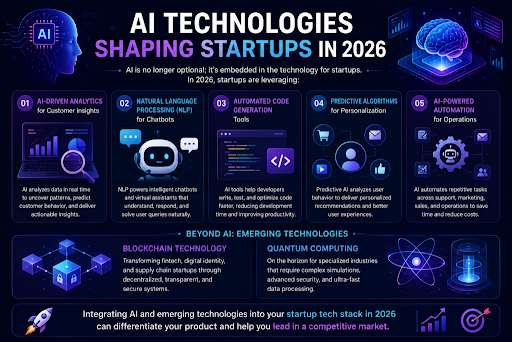
Artificial intelligence is no longer optional in modern business environments. In Startup Tech Stack in 2026, AI has become deeply integrated into how startups build products, automate workflows, improve customer experiences, and scale operations efficiently.
Modern startups are increasingly leveraging AI technologies such as:
- AI-driven analytics for deeper customer insights and smarter decision-making
- Natural language processing (NLP) for intelligent chatbots and virtual assistants
- Automated code generation tools to accelerate software development
- Predictive algorithms for personalized user experiences and recommendations
- AI-powered automation for customer support, marketing, and operations
AI tools are helping startups reduce manual work, improve productivity, and deliver highly personalized digital experiences that modern users expect.
Beyond AI, emerging technologies are also reshaping the Startup Tech Stack in 2026. Blockchain technology continues to transform fintech, digital identity, and supply chain startups through decentralized and secure systems. Quantum computing is gradually emerging for specialized industries that require complex simulations, advanced security, and high-speed data processing.
6. Working with a Website Development Company for Your Startup Tech Stack in 2026
Building the right Startup Tech Stack in 2026 requires more than choosing popular technologies. Founders often face challenges related to scalability, security, infrastructure planning, integrations, and long-term maintenance.
Partnering with a professional website development company helps startups make smarter technical decisions while avoiding costly mistakes during product development.
A reliable development partner can:
- Audit your startup tech stack for scalability and performance
- Recommend frameworks and technologies aligned with your business goals
- Handle complex third-party integrations and cloud infrastructure
- Improve application security and system reliability
- Provide ongoing maintenance, optimization, and technical support
- Accelerate product development and deployment timelines
Working with an experienced development team allows founders to focus on growth, marketing, fundraising, and product strategy while technical experts manage the core infrastructure and engineering processes.
For startups planning long-term growth, choosing the right technology partner is just as important as choosing the right startup tech stack.
7. Conclusion: Build Smarter with Element Labs Inc
The Startup Tech Stack in 2026 is more than just a collection of tools — it is the foundation of your product's scalability, security, performance, and long-term success. From selecting the best front-end and back-end frameworks to integrating AI, cloud infrastructure, and DevOps automation, every technology decision directly impacts your startup's future growth.
At Element Labs Inc, we help founders navigate these critical technical decisions with confidence. As a trusted website development company, we specialize in designing, building, and optimizing scalable digital products tailored to modern startup needs.
Whether you are launching a SaaS platform, AI-powered application, fintech solution, or scalable mobile product, our team helps you create a future-ready startup tech stack aligned with your business goals.