

blockchain
Blockchain Real World Use Cases Beyond Crypto in 2026

The conversation around blockchain has shifted dramatically. What started with Bitcoin is now powering industries far beyond digital currency.
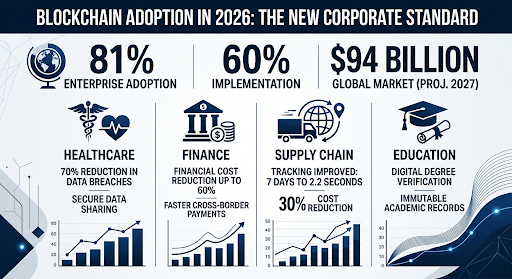
The conversation around blockchain has shifted dramatically. What started with Bitcoin is now powering industries far beyond digital currency. In fact, over 81% of global enterprises are actively exploring blockchain solutions, and nearly 60% have already implemented at least one use case. This is no longer hype — it's real transformation.
By 2026, the global blockchain market is projected to surpass 94 billion dollars, growing at over 56 percent annually (Statista). For business leaders, this means blockchain is no longer a tech experiment — it is a competitive advantage.
Today, blockchain beyond cryptocurrency is solving real business problems: improving transparency, reducing fraud, and creating trust in systems that once relied on intermediaries.
1. Why Blockchain Real-World Use Cases Are Moving Beyond Crypto in 2026
Blockchain is essentially a secure, transparent, and tamper-proof digital ledger. While crypto introduced the technology, industries quickly realized its broader value.
Here's why adoption is accelerating:
- Reduced fraud: Immutable records prevent tampering
- Transparency: Every transaction is traceable
- Efficiency: Eliminates middlemen and manual processes
- Cost savings: Businesses report up to 30% reduction in operational costs
This shift is driving emerging blockchain use cases across sectors.
Traditional Systems vs Blockchain Systems
Here is a quick look at how blockchain compares to traditional business systems:
| Factor | Traditional Systems | Blockchain Systems |
|---|---|---|
| Trust | Relies on intermediaries | Built into the network |
| Speed | Hours to days | Seconds to minutes |
| Cost | High processing fees | Low transaction costs |
| Transparency | Limited visibility | Full traceability |
| Security | Centralized risk | Distributed protection |
| Errors | Manual reconciliation | Automated verification |
This is why so many industries are moving toward blockchain based systems for processes that require trust, speed, and accuracy.
2. Blockchain in Healthcare

One of the most impactful areas is blockchain in healthcare. Healthcare systems often struggle with data fragmentation and security issues. Blockchain fixes this by creating a single, secure patient record accessible across providers.
Real-world example:
- IBM partnered with healthcare providers to build blockchain-based medical data systems
- MedRec enables patients to control their own medical records
- In India, Apollo Hospitals and the National Health Authority have explored blockchain to support the Ayushman Bharat Digital Mission. The goal is to give over a billion people secure, portable access to their medical records.
For hospitals, this means lower administrative costs, faster insurance claim approvals, and stronger patient trust. For patients, it means having control over their own health data, no matter which provider they visit.
Impact:
- Reduces medical errors
- Improves patient data security
- Speeds up insurance claims processing
3. Blockchain in Supply Chain

Another powerful example of blockchain real-world use cases is logistics and supply chain management. Supply chains are highly complex and involve manufacturers, suppliers, transport companies, warehouses, retailers, and customers. Blockchain technology helps create transparent, tamper-proof, and real-time tracking systems across the entire supply chain.
Real-World Examples
- Walmart uses IBM Food Trust to track food products. The tracking time for mangoes dropped from 7 days to just 2.2 seconds.
- De Beers uses Tracr, a blockchain platform that verifies the origin of every diamond, helping eliminate conflict diamonds from the global market.
- Maersk and IBM developed TradeLens to digitize global shipping operations, reducing paperwork delays by up to 40 percent.
- In India, ITC Limited and Mahindra Group are exploring blockchain systems to track agricultural products from farms to retail stores. This improves transparency, helps farmers receive fair pricing, and allows consumers to verify product authenticity.
Key Benefits of Blockchain in Supply Chain
- Real-time product tracking
- Reduced counterfeit goods
- Faster product recalls
- Better transparency and trust
- Improved operational efficiency
4. Blockchain in Finance Industry

The Blockchain Real-World Use Cases in the finance industry are growing rapidly beyond cryptocurrencies. Traditional banking systems are often slow, expensive, and dependent on multiple intermediaries, especially for international transactions. Blockchain technology helps financial institutions process transactions faster, improve security, and reduce operational costs.
Real-World Examples
- Ripple enables near-instant global transactions using blockchain-powered payment systems.
- Banks using Ripple technology can reduce international transaction costs by up to 60 percent while improving settlement speed.
- JPMorgan Chase has already launched blockchain-based payment networks for faster and more secure institutional transactions.
Major Blockchain Use Cases in Finance
- Cross-border payments
- Smart contracts for loans and insurance
- Fraud detection and prevention
- Digital identity verification
- Faster settlement systems
- Secure financial record management
The Rise of Decentralized Finance (DeFi)
Decentralized Finance, or DeFi, is one of the fastest growing blockchain applications. It allows people to lend, borrow, and earn interest without traditional banks. Platforms like Aave and Compound now manage billions in digital assets.
India also plays a leading role in this space. Polygon, founded by Indian developers, powers thousands of global decentralized applications and is one of the most widely used blockchain networks in the world. This shows that India is not just adopting blockchain — it is building the infrastructure for the next generation of finance.
5. Blockchain in Education
Another emerging area of blockchain real-world use cases is the education sector. Universities, colleges, and certification platforms often face challenges related to fake degrees, document verification delays, and credential management. Blockchain technology helps create secure, tamper-proof, and instantly verifiable academic records.
Real-World Examples
- Massachusetts Institute of Technology (MIT) issues blockchain-based digital diplomas that students can securely store and share online.
- Blockcerts enables instant verification of certificates and educational credentials without relying on third-party verification agencies.
Benefits of Blockchain in Education
- Eliminates fake degrees and certificate fraud
- Simplifies hiring and background verification
- Gives students ownership of academic credentials
- Reduces paperwork and administrative costs
- Enables instant global verification of records
6. Blockchain in Real Estate
Real estate is one of the most promising Blockchain Real-World Use Cases in 2026. Property ownership records, rental agreements, and real estate transactions are increasingly being digitized through blockchain technology and smart contracts. Traditional property transactions often involve lengthy paperwork, fraud risks, and legal disputes. Blockchain helps create transparent, secure, and tamper-proof property management systems.
Real-World Examples
- Sweden's land registry system has used blockchain technology to record property transactions, reducing transaction times from months to just days.
- In India, the states of Telangana and Andhra Pradesh have piloted blockchain-based land record systems to reduce fraud and speed up property ownership transfers.
Benefits of Blockchain in Real Estate
- Tamper-proof property ownership records
- Faster property sales and transfer processes
- Reduced fraud and legal disputes
- Lower paperwork and administrative costs
- Improved transparency in transactions
7. Blockchain in Government and Public Services
Governments around the world are adopting blockchain real-world use cases to improve transparency, security, and efficiency in public services. Blockchain technology helps governments create secure digital records, reduce corruption, and improve citizen services through tamper-proof systems and transparent data management.
Real-World Examples
- Estonia uses blockchain technology to secure nearly 99 percent of its government services, including healthcare systems, court records, and tax filing platforms. Citizens can securely sign documents, access medical records, and file taxes online.
- In India, blockchain is being explored for land record management, vaccine tracking systems, and digital identity verification through platforms like DigiLocker.
Benefits of Blockchain in Government Services
- Reduced corruption and fraud
- Faster and more efficient public service delivery
- Stronger citizen trust and transparency
- Secure digital identity management
- Lower administrative and operational costs
8. Emerging Blockchain Use Cases
Beyond major industries, Blockchain Real-World Use Cases are rapidly expanding into new and innovative sectors. As blockchain innovation grows in 2026, businesses and governments are discovering entirely new ways to use decentralized technology.
Digital Identity
Blockchain-based self-sovereign identity systems allow users to control their own personal data instead of relying on centralized platforms.
- Better privacy protection
- Reduced identity theft
- Secure digital verification
- User-controlled data sharing
Gaming & NFTs
Blockchain is transforming the gaming industry by enabling true ownership of in-game assets, digital collectibles, and virtual economies. Platforms like OpenSea allow users to buy, sell, and trade blockchain-based digital assets.
- True ownership of digital items
- Secure NFT trading
- Cross-platform virtual assets
- New monetization opportunities for gamers
Voting Systems
Blockchain-powered voting systems can create transparent and tamper-proof election processes.
- Reduced election fraud
- Improved transparency
- Faster vote verification
- Increased public trust in elections
Energy Trading
Blockchain technology is also enabling peer-to-peer energy trading and smarter energy management systems.
- Automated billing through smart contracts
- Efficient smart grid management
- Direct energy exchange between users
- Reduced operational costs
9. Blockchain in Media and Content
The creator economy is emerging as one of the most innovative Blockchain Real-World Use Cases in 2026. Content creators, musicians, writers, and digital artists are using blockchain technology to protect intellectual property, distribute royalties fairly, and prove ownership of digital content. Unlike traditional platforms that rely heavily on intermediaries, blockchain allows creators to connect directly with their audience and retain more control over their earnings.
Real-World Examples
- Audius gives musicians direct control over music distribution and monetization through decentralized streaming.
- Mirror enables writers and creators to publish content, build communities, and earn revenue directly from supporters.
Benefits of Blockchain in Media and Content
- Protection of intellectual property rights
- Transparent royalty distribution
- Verified ownership of digital content and artwork
- Direct creator-to-audience monetization
- Reduced dependence on middlemen
10. Blockchain Adoption Trends in 2026
The growth of Blockchain Real-World Use Cases is accelerating across industries, making blockchain one of the most important technologies shaping the digital economy in 2026.
Market Growth and Industry Adoption
- The global blockchain market is expected to reach nearly 94 billion dollars by 2027.
- More than 70 percent of enterprises plan to increase blockchain investments.
- Supply chain management and finance continue to lead blockchain adoption worldwide.
- AI and blockchain integration is rapidly becoming a major innovation trend.
Major Blockchain Trends Shaping 2026
Tokenization of Real-World Assets
Tokenization is transforming how physical and financial assets are managed. Real estate, artwork, stocks, and other assets are increasingly being converted into digital blockchain-based tokens. Experts predict that tokenized real-world assets could reach 10 trillion dollars by 2030.
Central Bank Digital Currencies (CBDCs)
More than 130 countries are actively exploring or testing Central Bank Digital Currencies. India is already testing its Digital Rupee initiative as part of the global CBDC movement.
Enterprise Blockchain Investment Growth
Enterprise blockchain spending is projected to exceed 19 billion dollars in 2026 as businesses continue adopting decentralized systems for operations, payments, and security.
AI + Blockchain Integration
Artificial Intelligence and blockchain technologies are increasingly being combined to create smarter automation systems and adaptive smart contracts. This integration is expected to transform industries such as finance, cybersecurity, healthcare, and logistics.
Green Blockchain Networks
Modern blockchain platforms are focusing heavily on sustainability and energy efficiency. New-generation blockchain networks can reduce energy consumption by up to 99 percent compared to older proof-of-work systems.
11. Challenges Businesses Face with Blockchain Real-World Use Cases
Although Blockchain Real-World Use Cases offer significant advantages, businesses must also understand the challenges involved before adopting blockchain technology at scale.
Major Challenges in Blockchain Real-World Use Cases
- High Initial Setup Costs: Building custom enterprise blockchain solutions often requires significant investment in infrastructure, development, and security systems.
- Limited Skilled Developers: The demand for experienced blockchain developers continues to exceed supply, making it difficult and expensive for companies to hire specialized talent.
- Regulatory Uncertainty: Many countries are still developing blockchain regulations, which can create uncertainty for businesses planning long-term blockchain investments.
- Integration with Legacy Systems: Many enterprises already rely on older software and operational systems. Integrating blockchain with existing infrastructure can be technically complex and time-consuming.
- Energy Consumption Concerns: Older blockchain networks based on proof-of-work mechanisms can consume large amounts of energy, raising sustainability concerns for businesses and governments.
How Blockchain Real-World Use Cases Are Overcoming These Challenges
The good news is that blockchain technology is evolving rapidly. Modern blockchain platforms like Polygon, Solana, and Hyperledger are becoming faster, more scalable, cost-efficient, and energy-efficient. Regulatory clarity is also improving across major markets such as India, the United States, and the European Union. The right blockchain development partner can help businesses successfully implement blockchain real-world use cases while avoiding costly mistakes and choosing the best platform for their long-term goals.
12. Future of Blockchain Technology
The future of Blockchain Real-World Use Cases is not about replacing existing systems completely — it is about improving trust, transparency, security, and operational efficiency across industries. As blockchain technology continues to mature, businesses and governments are focusing on practical implementations that solve real-world problems at scale.
Key Trends Shaping the Future of Blockchain Technology
- Integration with AI and IoT: Blockchain is increasingly being combined with Artificial Intelligence and the Internet of Things (IoT) to create smarter, automated, and highly secure systems — improving smart city infrastructure, automated supply chains, predictive analytics, and real-time device communication.
- More Scalable and Energy-Efficient Networks: Modern blockchain platforms are becoming faster, cheaper, and significantly more energy-efficient than earlier blockchain systems. Platforms like Polygon and Solana are helping businesses scale blockchain applications for mainstream adoption.
- Wider Enterprise Adoption: Large enterprises across finance, healthcare, logistics, retail, and government sectors are investing heavily in Blockchain Real-World Use Cases to improve transparency, automation, and security.
- Improving Global Regulations: Governments worldwide are gradually creating clearer blockchain regulations, helping businesses adopt blockchain technology with greater confidence and compliance. Major markets such as India, the United States, and the European Union are actively working on blockchain policy frameworks.
Businesses that adopt Blockchain Real-World Use Cases early can gain a strong competitive advantage through better transparency, automation, operational efficiency, and customer trust in the rapidly evolving digital economy.
13. How to Decide if Blockchain Real-World Use Cases Are Right for Your Business
Not every business needs blockchain technology. Before investing in Blockchain Real-World Use Cases, it is important to evaluate whether blockchain can truly solve your business challenges and improve operational efficiency.
Ask These Questions Before Adopting Blockchain
- Do you handle sensitive data that requires high security?
- Does your business involve multiple parties that need to trust each other?
- Are you spending too much on intermediaries or middlemen?
- Do you need full transparency in your supply chain or transactions?
- Could your business benefit from smart contracts and automation?
If your answer is "yes" to two or more of these questions, Blockchain Real-World Use Cases could deliver significant value to your business.
Start with a Small Blockchain Pilot Project
If you are unsure about full-scale adoption, the smartest approach is to begin with a small pilot project. A pilot project helps businesses:
- Test blockchain capabilities with lower risk
- Measure operational improvements
- Understand implementation challenges
- Calculate potential return on investment
- Choose the right blockchain platform for future growth
Many successful companies started by testing small Blockchain Real-World Use Cases before expanding blockchain across larger business operations.
14. How Elementlabs Can Help You
At Elementlabs, we help businesses move from blockchain curiosity to real-world implementation. Whether you want to build smart contracts, launch an NFT marketplace, modernize supply chain tracking, or develop enterprise blockchain systems, our team creates scalable and secure solutions tailored to your industry needs.
Industries We Serve
- Healthcare and pharmaceutical
- Finance and fintech
- Retail and supply chain
- Real estate and government
- Media and entertainment
Our Blockchain Services
Our experts handle the complete blockchain development lifecycle, including:
- Blockchain consulting and strategy
- Architecture and infrastructure design
- Smart contract development
- dApp (Decentralized Application) development
- NFT marketplace development
- Enterprise blockchain integration
- Security optimization and testing
- Post-launch maintenance and support