
How to Create an NFT Project and Make Money (2026 Guide)
NFTs (Non-Fungible Tokens) have transformed digital ownership across art, gaming, real estate, and membership communities. While hype cycles have cooled since 2021, NFTs remain a powerful Web3 business model when executed strategically.
- How to Create an NFT Project and Make Money (2026 Guide)
- How NFT Projects Make Money
- Step-by-Step: How to Create an NFT Project
- NFT Project Cost Breakdown (Estimated)
- Common Reasons NFT Projects Fail
- Future of NFTs (2026 & Beyond)
- Final Thoughts
How to Create an NFT Project and Make Money (2026 Guide)
What is an NFT?
An NFT (Non-Fungible Token) is a unique digital asset stored on a blockchain that verifies ownership and authenticity of a specific item. Unlike Bitcoin or Ether, which are interchangeable on a 1:1 basis, each NFT is distinct. Two NFTs in the same collection are not equivalent — each carries its own identity, history, and verifiable provenance.NFT Blockchains Dominating in 2026
- Ethereum powers around 62% of all NFT contracts, maintaining its lead as the primary NFT blockchain
- Solana processes roughly 18% of NFT transactions, driven by high-throughput, low-fee mints
- Polygon powers about 11% of total NFT minting, including enterprise drops from Nike and Starbucks
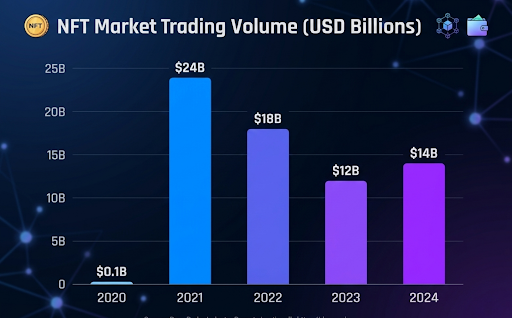
NFT Market Trading Volume (USD Billions)
How NFT Projects Make Money
There are several monetization models:
1️⃣ Primary Mint Sales
The most direct model. You set a mint price, define a supply, and sell NFTs at launch. A well-executed launch with a genuine community behind it can generate significant revenue in a short window.
Example: 5,000 NFTs at a mint price of $150 each generates $750,000 in primary revenue before costs.
- 5,000 NFTs × $150 mint price = $750,000 revenue
2️⃣ Royalties on Secondary Sales
Smart contracts can encode automatic royalties on every resale of your NFT, typically ranging from 5% to 10% of the transaction value, paid directly to the creator’s wallet.
For collections that maintain trading activity, royalties create a passive, ongoing revenue stream with zero additional effort.
3️⃣ Utility-Based Revenue
This is the model that defines 2026. NFTs that unlock something — exclusive content, event access, gaming items, SaaS platform features, or community membership — generate value through utility rather than speculation.
NFTs can unlock:
- Exclusive content
- Event access
- Gaming assets
- SaaS memberships
4️⃣ Brand Partnerships
Established NFT projects with strong communities attract brand collaborations, sponsored drops, influencer partnerships, and licensing deals.
This model requires scale but represents one of the highest-margin revenue channels for mature projects.
Step-by-Step: How to Create an NFT Project
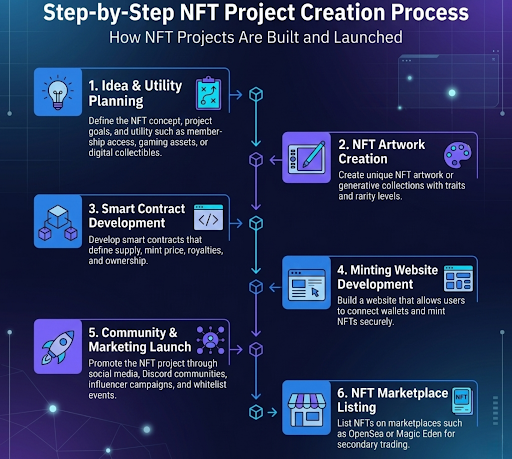
Step 1: Choose Your Niche & Value Proposition
The Strongest NFT Niches in 2026- Gaming NFTs as in-game assets, skins, and characters that function inside products people
- Ticketing and events verifiable, fraud-resistant, transferable event access replacing
- Real-world asset tokenisation fractional ownership of physical assets represented on-
- Creator communities membership-based access to exclusive content, tools, and direct
- Brand loyalty programmes corporate NFT drops tied to rewards, discounts, and
Step 2: Design NFT Artwork
NFT artwork exists across a spectrum from single unique pieces to large generative collections. The format you choose determines your technology stack and your community dynamics. Artwork Formats- 1 of 1 Art Pieces single unique works sold at auction. High value per piece, limited scale. Common in fine digital art markets.
- Generative Collections algorithmically combined traits producing thousands of unique outputs (commonly 5,000 to 10,000 items). The most common format for PFP and community-driven projects.
- Adobe Illustrator and Photoshop for layer-based trait design and character art
- Blender for 3D generative art and animated NFTs
- AI-assisted generation tools for texture and variation, used alongside human art direction
- Hashlips Art Engine for combining trait layers into generative output at scale
Step 3: Develop Smart Contracts
The smart contract is the technical backbone of your NFT project. It governs everything: what your NFT is, who can mint it, how much it costs, how many exist, and what royalty percentage flows back to you on every secondary sale. A Production-Ready NFT Smart Contract Defines- Token standard ERC-721 for unique tokens, ERC-1155 for semi-fungible gaming assets
- Mint price and supply cap fixed parameters that govern scarcity and primary revenue
- Royalty structure encoded via EIP-2981, the on-chain royalty standard
- Metadata and IPFS storage decentralised, permanent storage of artwork and trait data
- Whitelist and allowlist functionality tiered access for early community members
- Reveal mechanisms for collections with artwork hidden at mint and revealed later
Step 4: Choose NFT Marketplace
Where you list your NFTs determines which buyers see them, what fees are applied, and what tools are available to you as a creator. The three dominant platforms in 2026 each serve a different audience.- OpenSea processed $4.2 billion in cumulative volume during Q4 2025, evolving into a broader multi-asset trading platform
- Blur captured 38% of Ethereum NFT volume in early 2026, targeting professional traders with zero marketplace fees
- Magic Eden leads Solana and Bitcoin Ordinals trading with $6.39 billion in cumulative trading volume’
Step 5: Build Community Before Launch
Community is not a marketing channel for an NFT project. It is the product. The strength of your community at launch determines whether your mint sells out and whether your project has a secondary market at all. A minimum of 60 to 90 days of community building before launch is considered baseline for a project aiming to sell out its initial mint. Platforms That Drive NFT Communities in 2026- Discord the primary home for NFT communities, used for announcements, whitelist access,
- X (formerly Twitter) where project discovery, influencer partnerships, and pre-launch hype
- Telegram fast-moving communication for active trader communities and international
- Whitelist campaigns reward early community members with guaranteed mint access at
- Twitter Spaces and AMAs direct founder communication builds trust at a level that written
- Airdrop campaigns distribute free NFTs to targeted wallet addresses to build awareness
- Influencer collaborations partner with credible Web3 creators, not generic social media
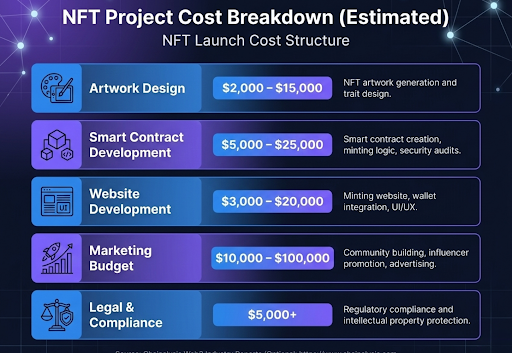
NFT Project Cost Breakdown (Estimated)
Understanding total project costs before launch prevents the most common financial failure mode: running out of budget before marketing even begins. Two critical notes on this breakdown. First, the marketing budget is the category most founders underestimate. A technically excellent project with a $2,000 marketing budget will underperform a technically average project with a $30,000 community-building spend. Second, the smart contract audit line is non-negotiable for any project holding real funds. An unaudited contract is a liability, not a cost saved. Legal Considerations You Cannot Ignore The legal landscape around NFTs has developed significantly since 2021, and ignorance of it is not a defence. Four areas require legal clarity before launch. • Copyright and IP ownership owning an NFT does not automatically grant the buyer copyright over the underlying artwork unless your smart contract and terms explicitly state otherwise • Securities regulations NFTs structured to promise future returns or marketed as investment vehicles may be classified as securities under applicable law • Tax implications NFT sales, royalties, and trading are taxable events in most jurisdictions for both creators and buyers • Jurisdiction compliance your project’s legal structure, where funds are received, and where your team is based all affect which legal frameworks apply The U.S. Securities and Exchange Commission and IRS both maintain active guidance on digital assets. Consulting a blockchain-specialised attorney before launch is not optional for any project raising material funds. NFT Launch Cost Structure| Category | Estimated Cost |
|---|---|
| Artwork Design | $2,000 – $15,000 |
| Smart Contract Development | $5,000 – $25,000 |
| Website Development | $3,000 – $20,000 |
| Marketing Budget | $10,000 – $100,000 |
| Legal & Compliance | $5,000+ |
Common Reasons NFT Projects Fail
The 2026 market has separated into two tiers. Projects with real utility, strong community, and proper execution succeed. Others fail due to predictable mistakes.- No utility at launch: No real value = no retention
- Weak marketing: No awareness means no mint success
- Unaudited smart contracts: Security risks destroy projects
- No clear roadmap: Vague promises reduce trust
- Bad timing + no community: Leads to guaranteed failure
Future of NFTs (2026 & Beyond)
Google Trends data shows NFT interest shifted from hype to utility-focused use cases. High-Growth NFT Categories- Real-world asset tokenisation: Real estate, luxury goods
- Gaming NFTs: ~25% of market share, rapidly growing
- Digital identity: Certifications & credentials
- AI-powered NFTs: Dynamic, evolving tokens
Final Thoughts
Creating a profitable NFT project in 2026 is achievable — but not easy. Successful projects are built on: utility, community, security, and execution.Launch Checklist
- Clear utility from day one
- Audited smart contracts
- 60–90 days community building
- Strong marketing budget
- Legal compliance
- Clear roadmap with deadlines