
How AI is Transforming Indian Farming: 7 Innovations Unveiled at India AI Impact Summit 2026
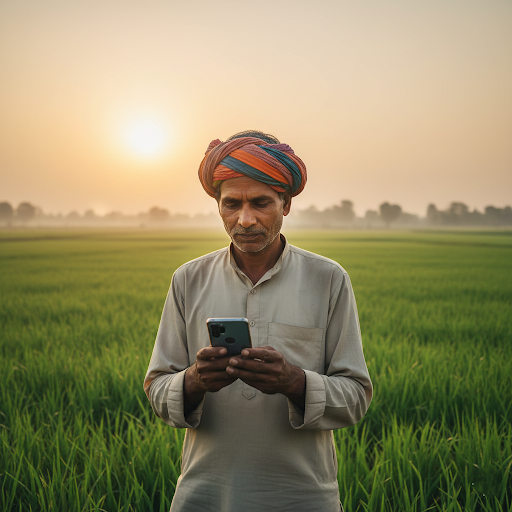
India’s farmers just got superpowers and the India AI Impact Summit 2026 is where it became official.
At the landmark India AI Impact Summit 2026 in New Delhi, Prime Minister Modi delivered a message that reframed the entire conversation around AI in agriculture: “AI isn’t a risk, it’s the solution India’s farmers have been waiting for.”
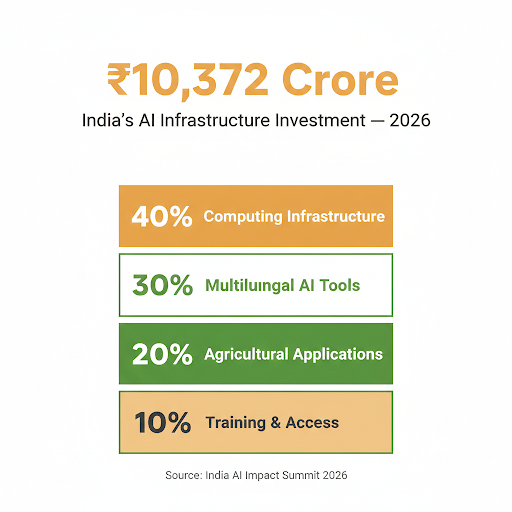
For decades, Indian agriculture has been at the mercy of unpredictable weather, pest outbreaks, water scarcity, and exploitative middlemen. In 2026, that’s changing. The ₹10,372 crore IndiaAI Mission is the funding backbone for all seven innovations in this blog. Responsible AI India is no longer a policy document, it’s a functioning reality in farmers’ pockets, in 22 languages, on affordable smartphones.
If you’re building AI-powered mobile tools for agriculture or other sectors, Mobile App Development is where these products start.
This blog covers the most impactful AI innovations for Indian farming announced at the Summit, what they mean in practical terms for farmers across every state, and why the New Delhi Declaration signals a new era of data sovereignty and food security.
1. The Big Shift: India’s ₹10,372 Crore Bet on Responsible AI
Impact Summit 2026 opened with a statement of intent. The ₹10,372 crore investment in AI infrastructure isn’t spread evenly across sectors. A significant portion is directed specifically at agricultural tools that work in rural India’s real conditions: patchy connectivity, feature phones, and 22 languages that aren’t English.
This is the principle behind the New Delhi Declaration, signed at the close of the Summit. It commits India to building AI that is sovereign, multilingual, and accessible, not AI imported from Silicon Valley that treats Indian farmers as a market rather than as citizens.
French President Emmanuel Macron, who attended as a partner-nation delegate, captured the stakes: no country should be merely a passive consumer of foreign AI platforms. India’s Responsible AI framework is its answer to that challenge.
New Delhi Declaration: Core Commitments ✅ AI infrastructure on Indian soil (Indian data stays in India) |
2. MausamGPT: The AI Farm Advisor in Your Mother Tongue
The single most immediately practical announcement at the India AI Impact Summit 2026 was MausamGPT, India’s homegrown AI weather and farming advisor, built specifically for the 700 million Indians whose first language isn’t English.
What separates MausamGPT from the dozens of agricultural apps that have launched and quietly failed in India over the past decade is exactly this: it works in 22 Indian languages, runs on regular smartphones, and processes live local data, not generic national forecasts that are useless to a farmer in a specific district of Odisha or a specific valley in Himachal Pradesh.
MausamGPT’s multilingual capabilities are powered by Digital India Bhashini, the government’s AI translation engine supporting 36 text and 22 voice languages.
Delivering AI advice in 22 Indian languages requires inclusive interface design — that’s where Designing & Branding comes in.
A farmer in Punjab can ask in Punjabi: “ਕੀ ਅੱਜ ਸਿੰਚਾਈ ਕਰਨੀ ਚਾਹੀਦੀ ਹੈ?” (Should I irrigate today?) and receive an answer calibrated to live weather data, that day’s evapotranspiration rate, and the specific water needs of their crop at its current growth stage.
MausamGPT is part of the broader Indian LLMs ecosystem, the push to develop large language models that are genuinely multilingual rather than English-primary with translation layers bolted on. It is built on similar infrastructure to BharatGen, India’s multimodal AI model announced at the same summit.
3. BharatGen and Sarvam AI: India’s Homegrown Language Revolution
The India AI Impact Summit 2026 wasn’t just about applying existing AI to Indian problems. It was also about India building its own AI. Two launches stood out for agriculture specifically: BharatGen and Sarvam AI.
BharatGen: India’s Multimodal AI Model
BharatGen is India’s answer to GPT-4 and Gemini, a multimodal large language model built on Indian data, trained in Indian languages, and designed for Indian use cases. For agriculture, this matters for one critical reason: the AI advice your farming app gives is only as good as the data it was trained on.
Sarvam AI: Conversational AI for Rural India
Sarvam AI focuses specifically on voice and text interaction in Indic languages. For agricultural applications, this means farmers who cannot type, and many rural farmers cannot type fluently on a smartphone keyboard, can speak to AI tools in their own language and receive spoken responses. This is not a minor technical feature. It is the difference between an AI tool that works for educated urban users and one that works for the 240 million smallholder farmers who are the backbone of India’s food production.Indian LLMs — Key Differentiators vs. Foreign Models
| Foreign LLMs (GPT, Gemini) | Indian LLMs (BharatGen / Sarvam AI) |
| Trained primarily on English data | Trained on Indic language data |
| Generic agricultural recommendations | India-specific crop and climate knowledge |
| Data stored on foreign servers | Data stored on Indian servers — sovereign |
| Limited Indic language support | 22+ Indian languages natively |
| Text-primary interfaces | Voice + text for low-literacy users |
4. The AI Doctor for Plants: 40% Faster Diagnosis
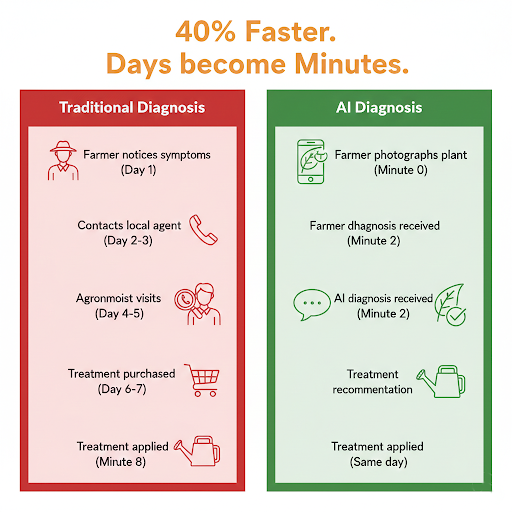
Crop disease and pest damage are responsible for an estimated 20–25% of India’s agricultural yield loss every year. The traditional response — wait until the problem is visible, call an agronomist, wait for the agronomist to arrive, receive a diagnosis, source treatment — takes days or weeks. By that point, the damage is done. The AI plant diagnosis tool announced at the India AI Impact Summit 2026 collapses that timeline to minutes. The same computer vision AI that detects plant disease 40% faster was originally developed for medical diagnostics and is now the WHO’s recommended tool for autonomous TB screening in India.How It Works
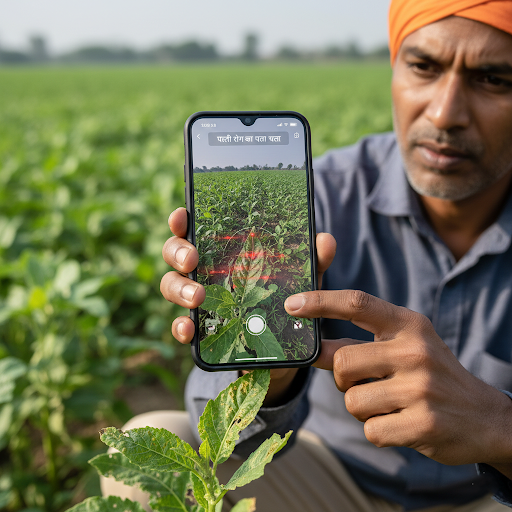
A farmer photographs a symptomatic plant with their smartphone. The AI trained on millions of images of crop diseases, pest damage, and nutrient deficiencies across Indian agriculture, diagnoses the problem with 40% faster accuracy than traditional visual inspection methods.
The technology is not new to medicine. The same computer vision AI that is already being deployed to detect tuberculosis and cancer in India’s rural health clinics has been retrained on agricultural data. The diagnostic principle is identical: pattern recognition on visual data at scale.
5. 58,000 GPUs: The Computing Foundation India Built
Every AI tool mentioned in this blog — MausamGPT, BharatGen, the plant diagnosis system, and flood prediction models — requires serious computing power to run at national scale in real time. At the India AI Impact Summit 2026, India announced it now has that infrastructure: 58,000 GPUs on Indian soil, with 20,000 added in the month of the Summit alone. To understand why this matters for farmers specifically, consider what happens without it. Hyper-local weather predictions that update every hour require live computation. Village-level flood warnings require real-time data processing. Crop disease diagnosis on millions of simultaneous photos requires GPU-scale parallelism. Without domestic computing infrastructure, all of this computation would happen on foreign servers, making India’s agricultural AI dependent on foreign platforms, foreign pricing, and foreign data policies.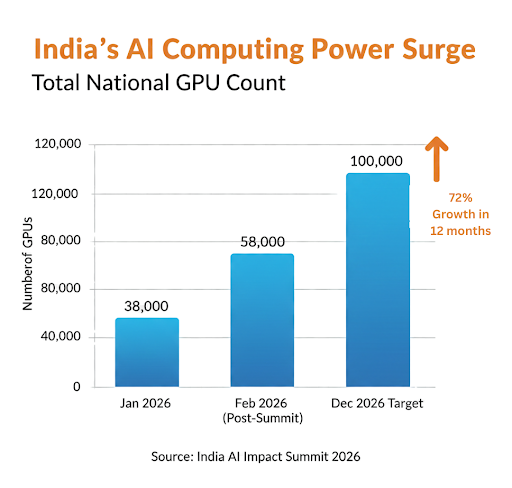
- Real-time weather predictions accurate to village level, updated hourly
- Simultaneous processing of millions of crop disease images from across India
- Local AI model training on Indian agricultural data without exporting it
- Lower costs: no payments to foreign cloud computing providers
- Data sovereignty: farm data, weather data, and usage patterns stay in India
6. Smart Water Management: BrahmaSATARK and the 35% Water Saving
Water scarcity is the defining agricultural challenge for the next 50 years in India. The Brahmaputra and Ganga river basins alone irrigate hundreds of millions of hectares and both are increasingly subject to extreme weather events: floods that destroy crops, droughts that starve them. BrahmaSATARK, the AI water management system unveiled at the India AI Impact Summit 2026, addresses both problems simultaneously. Built for the Brahmaputra and Ganga basins specifically, it does two things: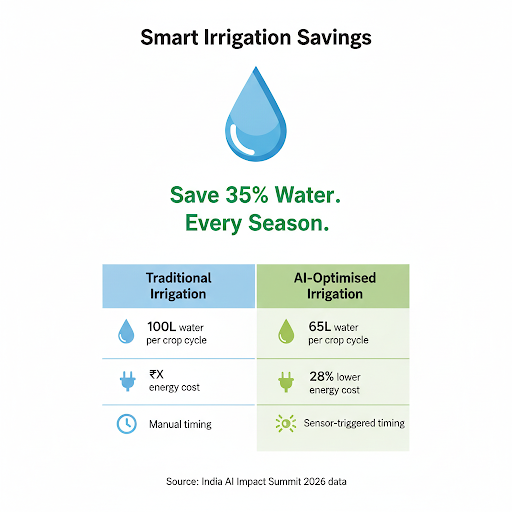
- Flood prediction: Models incoming flood events days before they occur, giving farmers time to harvest early, move livestock, and protect stored grain
- Irrigation optimisation: Calculates exactly when and how much water each crop needs based on real-time soil moisture, weather forecast, and crop growth stage
| Metric | Impact of AI-Optimised Irrigation |
| Water savings per crop cycle | 35% reduction |
| Energy cost reduction | 28% lower |
| Flood warning lead time | 3–5 days advance notice |
| Coverage area | Brahmaputra and Ganga river basins |
| Power source | 100MW renewable energy (Tata–OpenAI facility) |
7. From Village to Global Market: AI Cutting Out the Middleman
For generations, the biggest leakage in Indian agricultural value was the supply chain. A farmer grew the crop; by the time it reached the end buyer, 40% or more of the value had been captured by intermediaries, local traders, state agents, and national distributors at every stage. AI is restructuring this supply chain by connecting farmers directly to markets, removing unnecessary intermediaries, and enabling price discovery in real time. These AI-direct marketplaces run on robust web infrastructure, the kind our Web Development team builds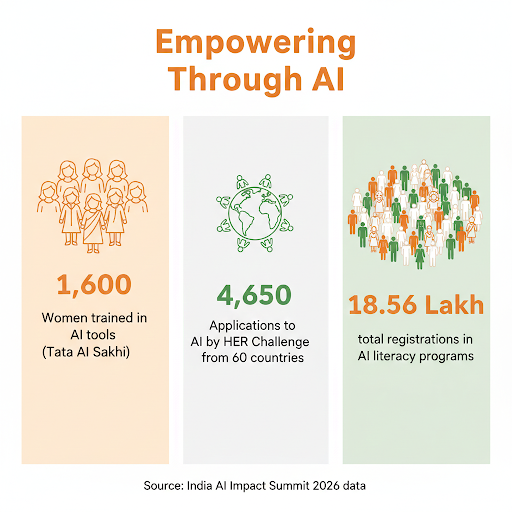
8. Women and Youth: Building AI, Not Just Using It
One of the most important signals from the India AI Impact Summit 2026 was who is leading the AI agriculture revolution, not just corporations and government departments, but young people and women.AI by HER Challenge
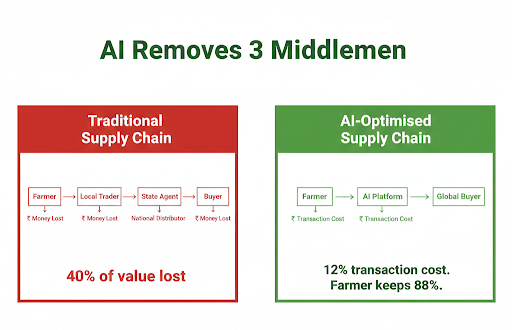
The AI by HER Challenge received 4,650 applications from 60 countries, with Indian women at the forefront. These aren’t users testing someone else’s tool, they are building AI solutions for problems they personally live with: water scarcity, crop disease, market access, soil degradation.YUVAi Youth Challenge (Ages 13–21)
- ₹85 lakh in prize money for young innovators solving real agricultural problems
- Winners receive funding to scale their solutions to national deployment
- Focus on practical AI solutions, must work in real field conditions, not just lab environments
9. The MANAV Framework: India’s Ethical AI Vision
PM Modi introduced the MANAV framework at the India AI Impact Summit 2026 as India’s guiding principle for AI development not just in agriculture, but across all sectors. For farmers and rural communities, MANAV is the guarantee that AI tools will be designed for them, not merely deployed on them.| MANAV Principle | What It Means for Indian Farmers |
| M – Moral | AI decisions are ethically grounded, no algorithmic bias against smallholder farmers or marginalised communities |
| A – Accountable | Transparent systems, farmers can understand and challenge AI recommendations |
| N – National Sovereignty | Indian farm data stays in India not processed on foreign cloud infrastructure |
| A – Accessible | Available to all Indians, in all languages, on affordable devices |
| V – Valid | AI that actually works in real Indian field conditions not just in lab benchmarks |
The MANAV framework directly addresses the AI Ethics Summit discussions that ran in parallel at the India AI Impact Summit 2026. India’s contribution to the emerging global conversation on AI governance, which is increasingly recognising that ethical AI cannot be defined only by Western regulatory frameworks.
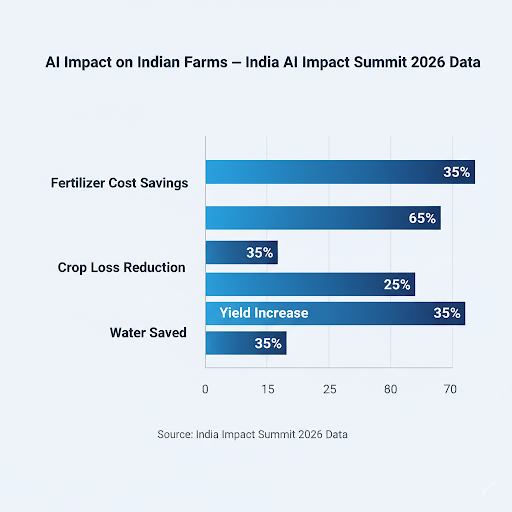
The Numbers That Matter: Real Impact on Real Farms
Abstract technology announcements only matter when they translate into measurable outcomes for farmers. Here is what the AI tools announced or expanded at the India AI Impact Summit 2026 are already delivering:
Direct Farm Income Impact
Metric | AI-Driven Result |
Fertilizer cost savings | 30–40% through precision application |
Crop loss reduction | 60–70% through early disease detection |
Yield improvement | 25% increase through optimised irrigation |
Water saved per crop cycle | 35% reduction (BrahmaSATARK) |
Supply chain cost | Reduced from ~40% to ~12% with direct AI platforms |
AI literacy reach | 18.56 lakh people trained in AI agricultural tools |
What Happens Next: The Scale-Up Roadmap
The India AI Impact Summit 2026 wasn’t a launch event, it was a progress review. Most of the tools described here are already deployed, already in farmers’ hands. The question now is scale.- MausamGPT is already in daily use by thousands of farmers across Punjab, Maharashtra, and Rajasthan
- AI disease detection is rolling out across additional states with state agriculture departments leading adoption
- BrahmaSATARK smart irrigation systems are being installed in the most drought-prone districts
- Tata AI Sakhi is expanding beyond its initial 1,600 women to reach rural communities in 15 states
- YUVAi winners are receiving their scaling grants, first deployments expected by Q3 2026
| PM Modi at India AI Impact Summit 2026 “AI gives us the roadmap, but humans must remain at the wheel.” Prime Minister Narendra Modi, India AI Impact Summit 2026, New Delhi |
| Want weekly AI insights for Indian businesses? Follow Element Labs for updates on AI innovations, Indian tech success stories, and practical business intelligence. Explore our blog for insights on technology trends affecting Indian businesses. → Related: India AI Impact Summit 2026 (Complete Coverage) → Related: How Indian Startups Are Solving Agriculture’s Hardest Problems → Related: MANAV Framework: India’s Ethical AI Vision Explained |
| LinkedIn “The India AI Impact Summit 2026 just showed the world what Responsible AI India looks like in practice. ₹10,372 crore invested. 58,000 GPUs on Indian servers. MausamGPT in 22 languages. BharatGen multimodal AI. 18.56 lakh people trained. This isn’t future tech. It’s happening right now in India’s fields. #IndiaAI2026 #ResponsibleAI #AgriTech #BharatGen #SarvamAI #NewDelhiDeclaration” |
| Instagram Caption “Swipe to see how the India AI Impact Summit 2026 is changing farming forever 🌾📱 From MausamGPT weather advice in your language to BharatGen’s multimodal AI — the future of Indian agriculture is here. 7 innovations. Real results. For 700 million farmers. 🇮🇳✨ #IndiaAI #BharatGen #SarvamAI #SmartFarming #ResponsibleAI #TechForGood #IndiaAISummit2026″ |