
web apps
PWA vs Native App: Which Is Right for Your Business? in 2026
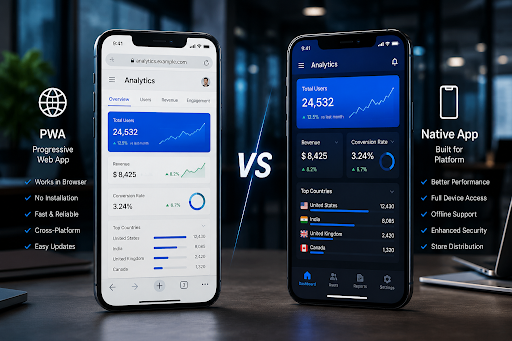
We break down PWA capabilities, native app advantages, cost comparisons, performance benchmarks, and SEO implications to help founders choose the right development strategy.
Businesses launching digital products today face an important technical decision: should they build a Progressive Web App or a Native Mobile App?
The debate around PWA vs native app development has become even more relevant in 2026 as companies look for faster, scalable, and cost-effective digital solutions. While Progressive Web Apps provide cross-platform accessibility through the browser, native apps offer deeper device integration and high-performance capabilities.
In this guide, we break down progressive web apps 2026 capabilities, native app advantages, cost comparisons, performance benchmarks, and SEO implications to help founders choose the right development strategy.
1. What Are Progressive Web Apps (PWAs) in 2026?
A Progressive Web App (PWA) is a web application designed to behave like a mobile app while running inside a browser. Built using modern web technologies such as HTML, CSS, and JavaScript, PWAs allow users to install an application directly from the browser without visiting an app store.
According to Google's Progressive Web Apps documentation, PWAs combine the reach of the web with the experience of native applications by using technologies like service workers, caching, and web app manifests.
Today, PWAs support many advanced features including offline usage, push notifications, and background synchronization. These capabilities allow businesses to deliver app-like experiences without requiring traditional mobile app installations.
2. PWA vs Native App: What PWAs Can Do in 2026
The capabilities of Progressive Web Apps have improved dramatically over the past few years. With improvements in browser APIs and mobile hardware, many PWAs now provide performance that rivals native applications for standard business use cases.
Key PWA Capabilities
- Offline functionality using service workers
- Push notifications across most devices
- Installable apps from browsers
- Background synchronization
- Camera and GPS access
- Secure authentication systems
Modern web technologies have enabled PWAs to achieve near-native performance for many applications. Developers interested in understanding these technologies can explore Mozilla's guide to Progressive Web Apps, which explains how service workers and caching systems power modern web apps.
Because of these improvements, many companies now consider PWAs a viable option for launching digital platforms quickly and efficiently.
3. PWA vs Native App: What PWAs Still Cannot Do
Despite their rapid evolution, Progressive Web Apps still have limitations compared to fully native applications.
Current PWA Limitations
- Limited access to certain hardware APIs
- Restricted background processing capabilities
- Reduced support for AR/VR applications
- Limited integration with advanced device sensors
Businesses launching digital products today face an important technical decision: should they build a Progressive Web App or a Native Mobile App? The debate around PWA vs native app development has become even more relevant in 2026 as companies look for faster, scalable, and cost-effective digital solutions. While Progressive Web Apps provide cross-platform accessibility through the browser, native apps offer deeper device integration and high-performance capabilities. In this guide, we break down progressive web apps 2026 capabilities, native app advantages, cost comparisons, performance benchmarks, and SEO implications to help founders choose the right development strategy.
 Source
4. PWA vs Native App: Native App Development Explained
Native apps are mobile applications built specifically for a particular operating system such as Android or iOS. Unlike PWAs, native apps are downloaded from app stores and installed directly on the device.
Native applications are typically developed using programming languages such as Swift for iOS and Kotlin for Android. Because they are built specifically for the operating system, they provide direct access to device hardware and system APIs.
Many organizations work with professional mobile app development services when creating native applications to ensure optimal performance, security, and scalability. Native development remains the preferred approach for applications that require advanced hardware access, real-time processing, or high performance.
5. PWA vs Native App: Native App Capabilities PWAs Lack
While PWAs offer flexibility and lower development costs, native applications still dominate in certain technical areas.
Key Native App Advantages
1. Full Hardware Integration
Native apps have unrestricted access to device features such as:
- Advanced Bluetooth functionality
- Biometric authentication
- Motion sensors
- Augmented reality frameworks
2. High-Performance Graphics
Applications that rely on high-performance graphics, such as gaming apps or AR platforms, benefit significantly from native development because they use direct GPU acceleration.
3. Advanced Background Processing
Native apps can perform complex background operations such as:
- Real-time GPS tracking
- Live communication services
- Continuous background computations
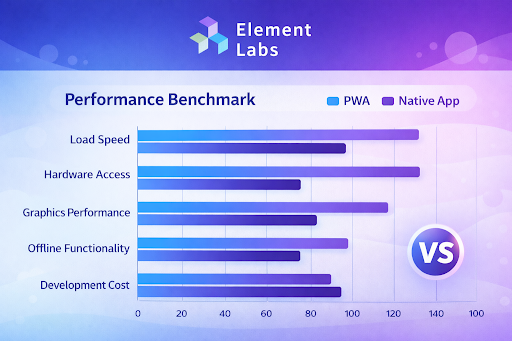
These capabilities make native apps ideal for fintech platforms, gaming products, healthcare applications, and advanced productivity software.
6. PWA vs Native App: Performance Comparison
Performance differences become clearer when we look at real-world applications. Progressive Web Apps like Twitter Lite, Starbucks, Pinterest, and Spotify are designed for speed, accessibility, and cross-platform compatibility. They work efficiently across devices with minimal installation requirements.
In contrast, native apps such as Instagram, Uber, and WhatsApp leverage full hardware capabilities. This enables smoother animations, deeper device integrations, and better performance for demanding use cases. This distinction is important for businesses choosing between wider accessibility and maximum performance.
| Metric | PWA | Native App |
|---|---|---|
| Load Speed | Fast | Very Fast |
| Hardware Access | Limited | Full |
| Graphics Performance | Moderate | High |
| Offline Capability | Strong | Excellent |
| Cross-Platform Reach | Excellent | Limited |
7. PWA vs Native App: Development Cost Comparison
Development cost is one of the biggest factors influencing the PWA vs Native App decision. PWAs typically require a single codebase that works across devices and operating systems, while native apps usually require separate development for Android and iOS platforms.
PWA vs Native App: PWA Development Cost
Typical PWA development costs include:
| Project Type | Estimated Cost |
|---|---|
| Startup MVP | $15,000 – $45,000 |
| Medium Platform | $40,000 – $100,000 |
| Enterprise Platform | $100,000 – $250,000 |
Because PWAs use modern web technologies, businesses often rely on custom web development solutions to build scalable applications that work seamlessly across multiple devices. This approach reduces development costs and simplifies maintenance because updates can be deployed instantly without waiting for app store approvals.
PWA vs Native App: Native App Development Cost
Native apps require larger development teams, platform-specific expertise, and longer development cycles.
Typical Native App Costs:
| Project Type | Estimated Cost |
|---|---|
| Startup MVP | $80,000 – $160,000 |
| Medium Platform | $150,000 – $300,000 |
| Enterprise Platform | $300,000+ |
8. PWA vs Native App: SEO Implications for Businesses
Search engine visibility is another major factor when evaluating Progressive Web Apps 2026 strategies. PWAs have a significant advantage because they are web-based and can be indexed directly by search engines. This allows businesses to generate organic traffic through traditional SEO strategies and content marketing efforts.
SEO Benefits of PWAs
- Search engine indexability
- Shareable URLs
- Faster page load speeds
- Lower installation friction
- Better discoverability through Google search
Because PWAs function like websites, businesses can optimize pages for keywords, backlinks, and search rankings just like traditional web platforms.
Native apps, on the other hand, rely primarily on App Store Optimization (ASO) instead of traditional search engine rankings. While app stores can improve app discovery, they generally do not provide the same long-term organic traffic opportunities as search engines. For businesses focused on SEO, lead generation, content marketing, or organic traffic growth, PWAs can provide a powerful competitive advantage.
9. PWA vs Native App: When a PWA Is the Better Choice
PWAs are particularly useful for businesses that prioritize accessibility, cost efficiency, and faster development cycles. They allow users to access products instantly through a browser without requiring app downloads or app store approvals. This reduces user friction, improves accessibility, and increases reach across multiple devices and operating systems.
Ideal PWA Use Cases
- E-commerce platforms
- SaaS dashboards
- Online booking systems
- Content publishing platforms
- B2B portals
Many successful platforms like Twitter Lite and Pinterest have adopted PWAs to improve engagement, increase accessibility, and maintain efficient development workflows.
10. PWA vs Native App: When Native Apps Are the Better Choice
Native apps are the ideal choice when performance, real-time interaction, and deep device integration are critical to the user experience. They provide smoother performance, faster responsiveness, stronger security, and access to advanced hardware features that PWAs still cannot fully utilize.
Ideal Native App Use Cases
- Social media platforms
- Ride-hailing and delivery apps
- Gaming applications
- Real-time communication tools
- Fintech and high-security apps
Applications like Instagram, Uber, and WhatsApp rely on native development to deliver high performance, real-time functionality, and seamless user experiences.
11. PWA vs Native App: What This Means for Your Business
If your priority is wider reach, faster deployment, and lower development costs, PWAs are a strong option. If your product depends on performance, scalability, advanced security, or deep hardware integration, native apps provide a clear long-term advantage. The best choice ultimately depends on your business goals, technical requirements, target audience, and long-term digital strategy.

Decision Framework for Founders
When deciding between a PWA and a native app, founders should evaluate several key factors.
✓ Choose a PWA if
- You want faster development
- Budget is limited
- SEO traffic is important
- Cross-platform accessibility is required
- Your product is content-focused
✓ Choose Native Apps if
- Your application requires advanced hardware integration
- Performance is critical
- The product involves gaming or AR/VR technology
- You need deep operating system integration
12. The Future of Digital Solutions
Both Progressive Web Apps and native apps offer powerful advantages, but the right choice ultimately depends on your business goals, technical requirements, target audience, and long-term product strategy.
PWAs provide cost efficiency, cross-platform accessibility, faster deployment, and strong SEO advantages, making them ideal for businesses focused on reach and rapid growth.
Native apps, on the other hand, deliver superior performance, advanced security, smoother user experiences, and deeper hardware integration for feature-rich applications.
13. Build Your Next Digital Product with Experts
Ready to turn your app idea into a scalable digital product? Whether you are planning a Progressive Web App or a high-performance Native Mobile App, Element Labs Inc helps businesses build secure, scalable, and future-ready mobile solutions tailored to real business goals.
From strategy and UI/UX design to full-scale development and deployment, their team delivers modern digital experiences optimized for performance, growth, and user engagement.
Why Choose Element Labs Inc?
- Custom PWA & Native App Development
- Scalable Architecture for Startups & Enterprises
- Modern UI/UX Design Solutions
- Cross-Platform & High-Performance Mobile Apps
- Long-Term Technical Support & Maintenance