

mobile apps
Common Security Risks in Mobile Apps and How to Fix Them

Whether you're building a startup MVP or scaling an enterprise platform, understanding security risks in mobile apps is essential. Discover the most common vulnerabilities and practical ways to protect your application.
In 2023 alone, more than 17 billion personal records were exposed globally due to cyber incidents and data breaches, according to cybersecurity industry reports. Poorly secured applications, weak authentication systems, and vulnerable APIs were among the leading causes.
If you're investing in mobile app development, ignoring security risks in mobile apps can become a costly mistake. A single vulnerability can damage your brand reputation, reduce customer trust, and lead to massive financial losses.
Whether you're building a startup MVP or scaling an enterprise platform, understanding security risks in mobile apps is essential. In this blog, you'll discover the most common mobile app vulnerabilities, learn from real-world security incidents, and explore practical ways to protect your application using modern cybersecurity practices.
You can also explore our related guides on: Mobile App Development Services Cybersecurity Solutions Blockchain Development Services
1. Security Risks in Mobile Apps: Data Breaches Can Cost Millions
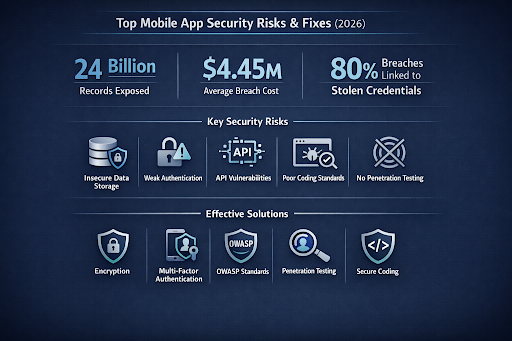
According to IBM's Cost of a Data Breach Report 2023, the average global cost of a data breach reached $4.45 million. Many of these cybersecurity incidents involved vulnerable mobile applications and insecure APIs.
One major example was Facebook, where API-related vulnerabilities contributed to massive user data exposure affecting millions of accounts. These types of Security Risks in Mobile Apps usually happen because of weak backend security, poor authentication systems, insecure cloud storage, or unprotected third-party integrations.
How to Fix Mobile App Data Breaches
- Implement strict access controls and role-based permissions
- Encrypt sensitive user data both in transit and at rest
- Regularly audit APIs and third-party integrations
- Use secure cloud storage configurations
- Enable multi-factor authentication (MFA) for user accounts
2. Security Risks in Mobile Apps: Ignoring the OWASP Mobile Top 10
The OWASP Foundation publishes the OWASP Mobile Top 10, a widely recognized list of the most critical mobile application security threats. The list includes risks such as insecure data storage, improper platform usage, weak cryptography, insecure communication, and insufficient authentication.
Many businesses and developers ignore these guidelines during the planning and development stages. This is one of the most common Security Risks in Mobile Apps, and it can leave applications vulnerable to cyberattacks, data leaks, and compliance issues.
How to Fix OWASP Mobile Security Risks
- Keep mobile SDKs, APIs, and libraries updated regularly
- Use the OWASP Mobile Top 10 as a security checklist before app launch
- Conduct regular code reviews based on industry security standards
- Integrate security testing early in the development lifecycle
- Perform penetration testing and vulnerability assessments
3. Security Risks in Mobile Apps: Insecure Data Storage
One of the most common security risks in mobile apps is insecure data storage. Sensitive information stored locally without proper encryption can be extracted from lost, stolen, or compromised devices.
Security researchers have previously identified cases where mobile applications stored login tokens and user credentials in plain text on Android devices. These issues can lead to serious Android and iOS security vulnerabilities when secure storage systems are not configured correctly.
How to Fix Insecure Data Storage in Mobile Apps
- Use encrypted storage solutions like Keychain (iOS) and EncryptedSharedPreferences (Android)
- Avoid storing passwords or sensitive authentication data locally
- Implement strong mobile app encryption techniques
- Secure session tokens and user credentials properly
- Regularly test apps for storage-related security vulnerabilities
4. Security Risks in Mobile Apps: Weak Authentication and Session Management
Weak authentication systems are one of the most critical Security Risks in Mobile Apps. Poor password protection, missing multi-factor authentication, insecure session handling, and exposed access tokens can give attackers easy access to user accounts and sensitive business data.
How to Fix Weak Authentication and Session Risks
- Enable multi-factor authentication (MFA) for all user accounts
- Use biometric authentication such as Face ID or fingerprint login
- Implement secure token expiration and session management
- Enforce strong password creation policies
- Use OAuth 2.0 and secure authentication protocols for APIs
5. Security Risks in Mobile Apps: API Attacks and Silent Threats

Modern mobile applications rely heavily on APIs to exchange data, process payments, manage user accounts, and connect third-party services. However, weak API protection has become one of the fastest-growing cybersecurity threats for mobile platforms.
In 2022, T-Mobile experienced a major data breach that exposed millions of customer records due to API-related security weaknesses. Poor authentication, exposed endpoints, and insufficient request validation are some of the most common causes of these attacks.
How to Prevent API Security Attacks
- Use secure API gateways and authentication layers
- Apply rate limiting to prevent abuse and automated attacks
- Validate and sanitize all server-side requests
- Avoid exposing sensitive endpoints publicly
- Monitor API traffic continuously for suspicious activity
6. Security Risks in Mobile Apps Caused by Lack of Secure Coding Standards
Many mobile applications become vulnerable because developers rush the release process without following secure coding practices. Hardcoded API keys, poor error handling, insecure coding logic, and outdated libraries can create major security gaps that attackers easily exploit.
Security should be integrated throughout the entire development lifecycle rather than treated as a final testing step. Building a security-first development culture helps reduce vulnerabilities and protects user data more effectively.
How to Improve Secure Coding Practices
- Train developers regularly on secure coding standards
- Use static code analysis and vulnerability scanning tools
- Keep frameworks, SDKs, and dependencies updated
- Conduct peer code reviews before deployment
- Follow industry security guidelines during development and testing
7. React Native Security Challenges
Cross-platform frameworks like React Native help developers build apps faster and reduce development costs, but they also introduce unique security challenges. Poor bridge configurations, exposed debug modes, insecure storage, and vulnerable third-party plugins can compromise application security if not handled properly.
That doesn't mean you should avoid React Native. With proper security practices, it can still be a powerful and secure framework for modern mobile app development.
How to Improve React Native Security
- Disable debug mode in production environments
- Secure communication between JavaScript and native modules
- Regularly update dependencies and third-party libraries
- Avoid storing sensitive data insecurely on devices
- Use code obfuscation and secure API communication methods
8. Skipping Penetration Testing
Many startups and businesses launch mobile applications without performing proper penetration testing. This can leave hidden vulnerabilities undiscovered until attackers exploit them in real-world scenarios.
Penetration testing allows ethical hackers to simulate cyberattacks and identify weaknesses before criminals can take advantage of them. It is one of the most effective ways to improve application security and reduce the risk of data breaches.
How to Strengthen App Security Through Penetration Testing
- Perform penetration testing before launching the application
- Re-test the app after major updates or feature releases
- Combine automated scans with manual security assessments
- Identify vulnerabilities in APIs, authentication systems, and data storage
- Fix detected security issues immediately and verify patches properly
9. Not Following Mobile Application Security Best Practices
Mobile app security is not a one-time task — it requires a layered and continuous approach. Many businesses focus only on development speed and ignore long-term security strategies, which increases the risk of cyberattacks, data leaks, and unauthorized access.
Following strong mobile application security best practices helps businesses build safer apps, protect sensitive customer information, and maintain user trust over time.
Essential Mobile App Security Best Practices
- Encrypt sensitive data both in transit and at rest
- Conduct regular vulnerability assessments and security audits
- Implement role-based access controls (RBAC)
- Monitor unusual login attempts and suspicious user activity
- Keep APIs, SDKs, and third-party libraries updated
- Use secure authentication and session management methods
10. Why Security Should Be Built Into Development
When security is integrated from day one, the cost of fixing issues drops dramatically. According to industry research, fixing a vulnerability after release can cost 30x more than resolving it during development.
At Elements Labs, we focus on building secure, scalable mobile solutions from the ground up. Our team integrates protection measures throughout the entire mobile app development lifecycle — not just at the end.
If you're planning a new project or want to audit an existing product, securing your platform today can save you from massive losses tomorrow.
11. Ready to Secure Your Mobile App?
In today's digital landscape, mobile app security is no longer optional — it's essential. One vulnerability can lead to data breaches, financial loss, damaged customer trust, and long-term brand reputation issues. Whether you're launching a startup MVP, scaling a growing platform, or modernizing an enterprise application, security should be built into every stage of development.
At Elements Labs, we help businesses create secure, scalable, and high-performance mobile applications designed to handle modern cybersecurity challenges. From secure app architecture and API protection to penetration testing and vulnerability assessments, our team focuses on building applications users can trust with confidence.
Why Businesses Choose Elements Labs
- Secure Android and iOS app development
- Advanced API and backend security implementation
- Mobile app penetration testing and vulnerability assessments
- Scalable architecture with modern cybersecurity standards
- Ongoing monitoring, maintenance, and security optimization