Web App vs Website: A Complete Decision Guide for Startups and Founders
- The Question Every Founder Gets Wrong
- What Is a Website?
- What Is a Web App?
- The Complexity Spectrum: Where Does Your Product Fit?
- Cost and Timeline Differences
- Hosting Requirements: A Critical Difference
- SEO Considerations for Web Apps vs Websites
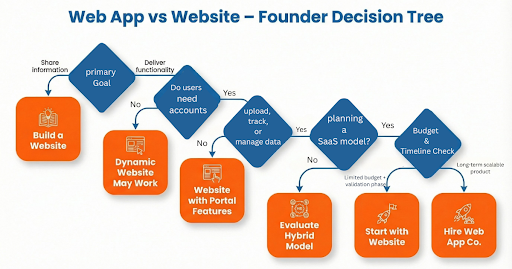
- Decision Flowchart for Founders
- Choosing the Right Digital Foundation
- Ready to Build the Right Digital Foundation?
The Question Every Founder Gets Wrong
Most founders ask ‘website or web app?’ when the real question is ‘what does my user actually need to do?’ That single shift in framing changes everything. A website and a web app are not competing options on a checklist. They are tools designed for fundamentally different jobs. One presents information. The other processes it. One builds trust. The other delivers functionality. Choosing the wrong one at the wrong stage of your business does not just waste the budget. It delays product market fit, confuses your users, and creates technical debt you will be untangling for years. The confusion is understandable. Both are accessed through browsers. Both are built with HTML, CSS, and JavaScript. From the outside, a polished website and a simple web app can look nearly identical. But under the surface, they are built for completely different purposes and require completely different development strategies. This guide cuts through the confusion. By the end, you will know exactly which one your business needs right now, what it will cost, how long it will take, and when to upgrade.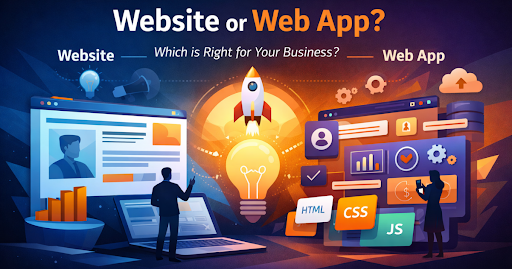
What Is a Web App?
A web app is interactive software that runs in a browser. Unlike a website, a web app allows users to perform actions, store and retrieve personal data, trigger automated workflows, and engage with a system that responds to their inputs in real time. Key Characteristics of a Web App- High interactivity with user specific data and personalised outcomes
- Login systems and user accounts with role based access control
- Backend databases, APIs, and server side logic running behind the interface
- Real time processing and dynamic content that updates based on user actions
- Business logic that drives user behaviour, decisions, and workflows
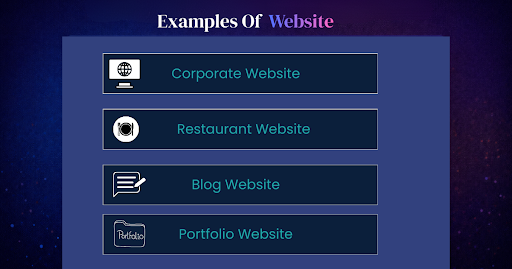
- A project management tool like Trello or Asana with tasks and team boards
- An online banking portal with account management, transfers, and statements
- A SaaS CRM system for sales teams to manage contacts and pipelines
- An E-commerce dashboard tracking orders, inventory, and customer data
- A healthcare platform with patient records and appointment scheduling
Understanding these differences helps you invest wisely in web application development, avoid unnecessary costs, and align your digital presence with your business goals. Whether you need a strong online presence, a customer portal, or a fully interactive product, this guide will help you decide and determine whether you need a simple website or a professional web app development company to build something more advanced.
What Is a Website?
A website is a collection of web pages built primarily to communicate information to visitors. It presents your brand, your services, your story, and your contact details. Users arrive, read, and leave. The interaction is largely one-directional.
Key Characteristics of a Website
- Mostly informational content with limited user interactivity
- Publicly accessible without requiring user accounts or login
- Optimised for search engines and built for lead generation
- Powered by CMS platforms like WordPress, Webflow, or Squarespace
- Focused on brand credibility and marketing conversion
Common Website Examples
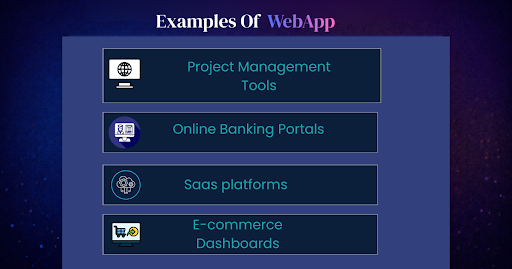
- A law firm’s site explaining services, team credentials, and case studies
- A restaurant site with menus, location, opening hours, and a booking form
- A startup landing page capturing waitlist signups before product launch
- A blog or content site publishing articles and newsletter signups
Web apps require structured web application development, including frontend development, backend systems, APIs, and databases. Understanding web application architecture fundamentals is essential when planning scalable systems.
The Complexity Spectrum: Where Does Your Product Fit?
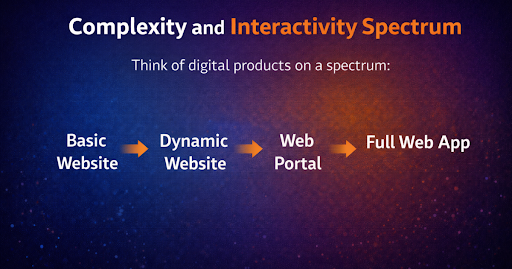
Websites and web apps are not a binary choice. They exist on a spectrum of complexity. Understanding where your product sits on this spectrum is the clearest way to make the right investment decision.
| Level | Type | Best For |
| Level 1 | Static Website | Portfolio sites, landing pages, coming-soon pages |
| Level 2 | Dynamic Website | Service businesses, agencies, early-stage startups |
| Level 3 | Web Portal | Membership communities, B2B platforms, client dashboards |
| Level 4 | Full Web App | SaaS products, fintech platforms, complex user workflows |
Level 1 products are pure HTML and CSS pages with no database, no server logic, and no user input. They are the fastest and cheapest to build and ideal for validating an idea before any significant investment.
Level 2 products are CMS-powered, typically built on WordPress or Webflow. They include blogs, contact forms, and editable content that can be managed without code. This is the right starting point for most service businesses and early-stage startups.
Level 3 products allow users to create accounts, log in, and access personalised content. Basic dashboards, profile management, and saved preferences are common at this level. These sit between a dynamic website and a full web app.
Level 4 products involve complex user workflows, real-time data updates, payment processing, third-party API integrations, and custom backend logic. This is full web application development territory and requires a dedicated engineering team.
Most startups begin at Level 2 and graduate to Level 4 as product-market fit is achieved and user demand justifies the investment.
Cost and Timeline Differences
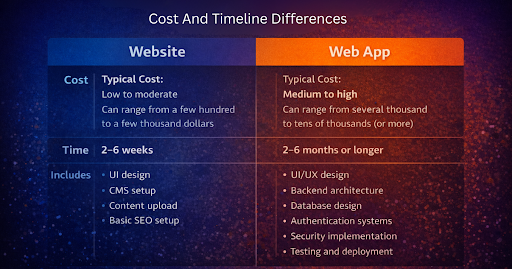
Understanding the financial and time investment is critical when deciding between a web app vs. a website.
Website Development
A business website is faster and more affordable because its purpose is content presentation, not computation. Most business websites are completed in 2 to 6 weeks, depending on the number of pages, design iterations, and content readiness. The cost covers UI design, CMS setup, content upload, SEO configuration, and basic performance optimisation. For early-stage founders, this investment is proportionate to the goal: establishing online presence, capturing leads, and building credibility before deeper product investment begins.Web App Development
Web application development requires a substantially larger investment of both time and money. The added scope includes backend architecture, database design, authentication systems, API development, security implementation, testing cycles, and staged deployment. Timelines typically begin at 3 to 4 months for a focused MVP and extend to 6 months or more for feature-rich platforms. The cost reflects the engineering depth involved, not simply the visual design. Many founders who work with a specialised web app development company find that this investment pays for itself once users begin transacting, subscribing, or managing their own data inside the platform. The clearest signal that you have crossed into web app territory: your users need to do something inside your product, not just read about it.Hosting Requirements: A Critical Difference
The infrastructure your product runs on is shaped entirely by what your product needs to do. Hosting is not just a technical detail — it is an ongoing operational cost and a scalability decision.Website Hosting
A business website runs comfortably on shared hosting. A basic SSL certificate, a CDN for performance, and a reliable hosting provider are sufficient for most informational sites. The costs are low, the setup is straightforward, and day-to-day maintenance is minimal.Web App Hosting
Web apps demand a fundamentally different hosting environment. Scalable cloud infrastructure is required to handle concurrent user requests, database queries, real-time updates, and application logic running simultaneously. This typically means VPS or cloud hosting on AWS, Google Cloud, or Microsoft Azure. The hosting environment for a web app also includes database management systems, security monitoring, automated backups, environment management across development, staging, and production, and ongoing performance optimisation. Founders investing in web application development for startups should plan infrastructure costs from day one. Retrofitting scalable hosting onto a platform built without it is significantly more expensive and disruptive than designing for it upfront.SEO Considerations for Web Apps vs Websites
Search engine optimisation works differently depending on what you have built. Understanding this distinction prevents a common and costly mistake made by founders who invest in a web app and then wonder why no one can find them on Google.Website SEO
A business website is built for discoverability. Every page, blog post, landing page, and service description is a crawlable asset. Search engines index the content, rank it for relevant queries, and drive organic traffic. This is the most reliable long-term source of inbound leads for service businesses and content-driven brands. Search engines crawl static and CMS-based websites easily. For best practices, refer to Google’s SEO Starter Guide.Web App SEO Challenges
Web apps present structural SEO challenges that websites do not face. JavaScript-heavy interfaces can be difficult for search engines to render. Login-protected content is invisible to crawlers by design. Dynamic URLs generated by user sessions are often not indexable. These factors mean that a web app, on its own, may generate little to no organic traffic regardless of how well-engineered it is. The solution most successful SaaS companies use is a hybrid model. A public marketing website optimised for SEO sits in front of the web app. The marketing site drives discovery, builds trust, and converts visitors. The web app delivers the actual product experience to signed-in users. This separation is not a workaround. It is the standard architecture for any product that needs both discoverability and functionality. When to Build a Website First: For early-stage founders, starting with a website is not a compromise. It is the strategically correct move.Build a website first if:
- Your idea is still being validated and demand is unproven
- You need inbound leads before your product is fully developed
- Your service can be delivered without user accounts or dashboards
- You want to test messaging and positioning before investing in complex development
- Your runway is limited and speed to market matters more than full functionality
When to Move to a Web App
The transition from website to web app is signalled by your users’ needs, not your ambitions. When the following requirements appear consistently in user feedback, support requests, or product conversations, it is time to invest in structured web application development.Upgrade to a web app when:
- Users need accounts to access personalised experiences and saved data
- Your service requires dashboards reporting, or performance tracking
- Automated workflows need to run based on user actions or scheduled triggers
- You are launching a subscription or SaaS product with recurring billing
- Payments, bookings, or file uploads are part of the core user experience
- Real-time interaction between users is central to your product’s value
Decision Flowchart for Founders
Use these five questions in order to determine the right starting point for your digital product. The answer to each question points you toward the right investment level.